Engage with industry experts, share insights, ask questions, and grow your network.
Recently active
The Challenge:Organizations deploying AI infrastructure often need ongoing operational support after initial deployment. Managing AI environments can require specialized expertise, and customers may want flexibility in how they source their AI Factory hardware while still benefitting from managed services.A Better Approach:Equinix Managed Solutions has expanded Managed AI Factory to support Dell AI Factory day-2 support and management. This gives customers an additional hardware choice when deploying AI Factories with Equinix while maintaining access to managed operational services.Dell AI Factory reference architectures can also support smaller deployment footprints than NVIDIA SuperPod scalable units, enabling managed AI deployments that fit a wider range of infrastructure requirements.When to Use This:When deploying a Dell AI Factory and seeking day-2 operational support and management from Equinix Managed Solutions When looking for greater flexibility in selecting AI Factory hardwa
Network Edge now provides visibility into the operational status of virtual network functions (VNFs), helping users understand the current runtime condition of their deployed services.What’s New:Operational status indicates the current runtime condition of a VNF Status visibility includes whether a VNF is actively processing traffic, suspended, powered off, or experiencing an error condition Users can view the current operational state of deployed VNFsWhy it Matters:Provides greater visibility into the runtime condition of VNFs Helps users quickly understand whether a VNF is actively operating or may require attention Supports day-to-day operational awareness within Network Edge environmentsLearn MoreDocumentation - Network Edge
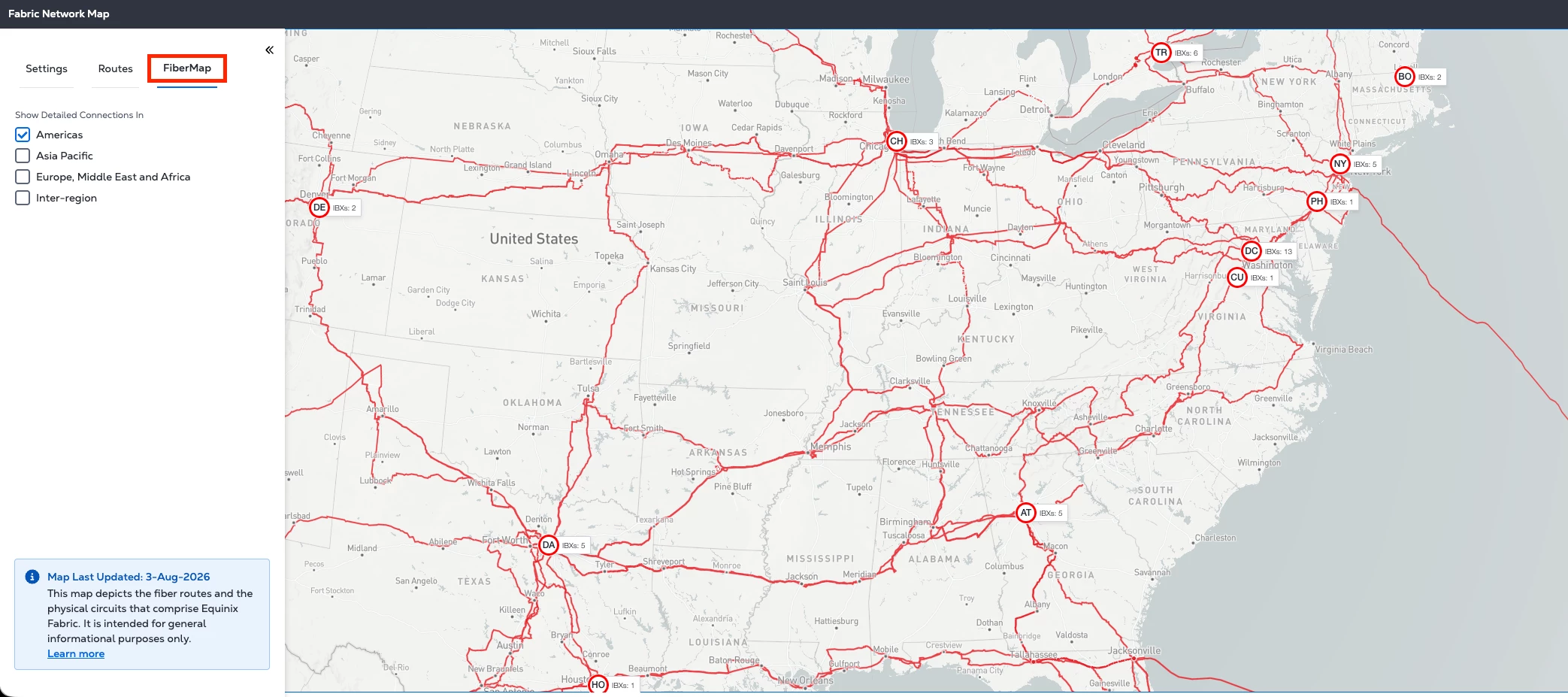
Customers can now gain greater visibility into the physical infrastructure supporting Equinix Fabric through the Fabric Network Map tool in Equinix Customer Portal. By selecting the new FiberMap tab, customers can select one or more regions to view the physical circuits and IBX locations that support Fabric services, helping them better understand the fiber paths underlying their connectivity.What’s New:View the underlying fiber paths used by the Equinix Fabric physical underlay network Toggle between the existing high-level network view and a more detailed fiber path view Visualize multiple individual fiber paths across network segmentsWhy it Matters:Provides additional visibility into the underlying network infrastructure Helps customers better understand network resiliency by viewing the fiber paths supporting Fabric connectivity Benefits Fabric users who want greater insight into the physical paths underlying their network connectionsLearn MoreDocumentation - FiberMap
Netskope Private Access (NPA) is now available on Network Edge, providing a new VPN offering that enables customers to securely manage access to their corporate resources.What’s New:Netskope Private Access (NPA) is now available on Network Edge Introduces a new VPN offering within the Network Edge marketplace Enables customers to securely manage access to their corporate resourcesWhy it Matters:Provides an additional secure access option through the Network Edge marketplace Supports organizations that need to manage access to corporate resources securelyLearn MoreEquinix Documentation - Network Edge
Following the successful launch in California, where SHRED expanded to San Jose, Santa Clara, and Palo Alto IBXs, we're excited to announce the next phase of our rollout across EMEA. This significantly increases our coverage and brings secure, sustainable e-waste disposal services to even more customers across the region.We are now launching SHRED (Smart Hands for Responsible Electronic Disposal) in the following IBXs:FR2, FR4, FR5, FR6, FR7, FR8, FR13, IL2, IL4, MU1, MU3, MU4, DU1, DX1, DX2, and AD1This expansion strengthens our global footprint and reflects the growing demand for responsible IT asset disposal solutions across our data centers.Simplify IT Asset Disposal While Supporting a Greener FutureWith SHRED, customers can securely and responsibly dispose of retired IT equipment while supporting their sustainability goals. SHRED ensures electronic waste is handled according to the highest standards of security and environmental responsibility.What is SHRED?SHRED is a Smart Hands
Equinix Managed Solutions has expanded into Melbourne and Sydney, extending access to managed private cloud, storage, AI, backup, and enablement services in Australia.What’s New:Equinix Managed Solutions (EMS) is now available in Melbourne Equinix Managed Solutions (EMS) is now available in Sydney Customers can access the EMS portfolio, including managed private cloud, storage, AI, backup, and enablement services, in both metrosWhy it Matters:Expands access to Equinix Managed Solutions for customers operating in Australia Provides managed private cloud, storage, AI, backup, and enablement services in Melbourne and Sydney Helps organizations simplify infrastructure operations by shifting day-to-day management to Equinix Supports cloud, AI, and digital transformation initiatives without requiring customers to build and operate infrastructure themselves Supports requirements for dedicated infrastructure hosted in AustraliaLearn MoreManaged IT Solutions for the Managed Data Center | Equini
The Challenge:Organizations in government, finance, healthcare, and other regulated industries must ensure sensitive traffic remains within specific jurisdictions and complies with applicable regulations. This challenge extends beyond where data is stored to how network traffic moves between locations, clouds, and applications.Today, customers often rely on public internet routes or cloud service provider backbones that do not provide deterministic routing evidence or granular control over where traffic traverses. This can create trade-offs between compliance requirements and operational flexibility.A Better Approach:Now generally available, Fabric Geo Zones enables customers to enforce geographic routing boundaries for network traffic. Customers apply policy-based routing controls, such as keeping traffic within a specific country or region, helping support sovereignty and compliance requirements.Fabric Geo Zones is delivered through new Fabric virtual connections that include soverei
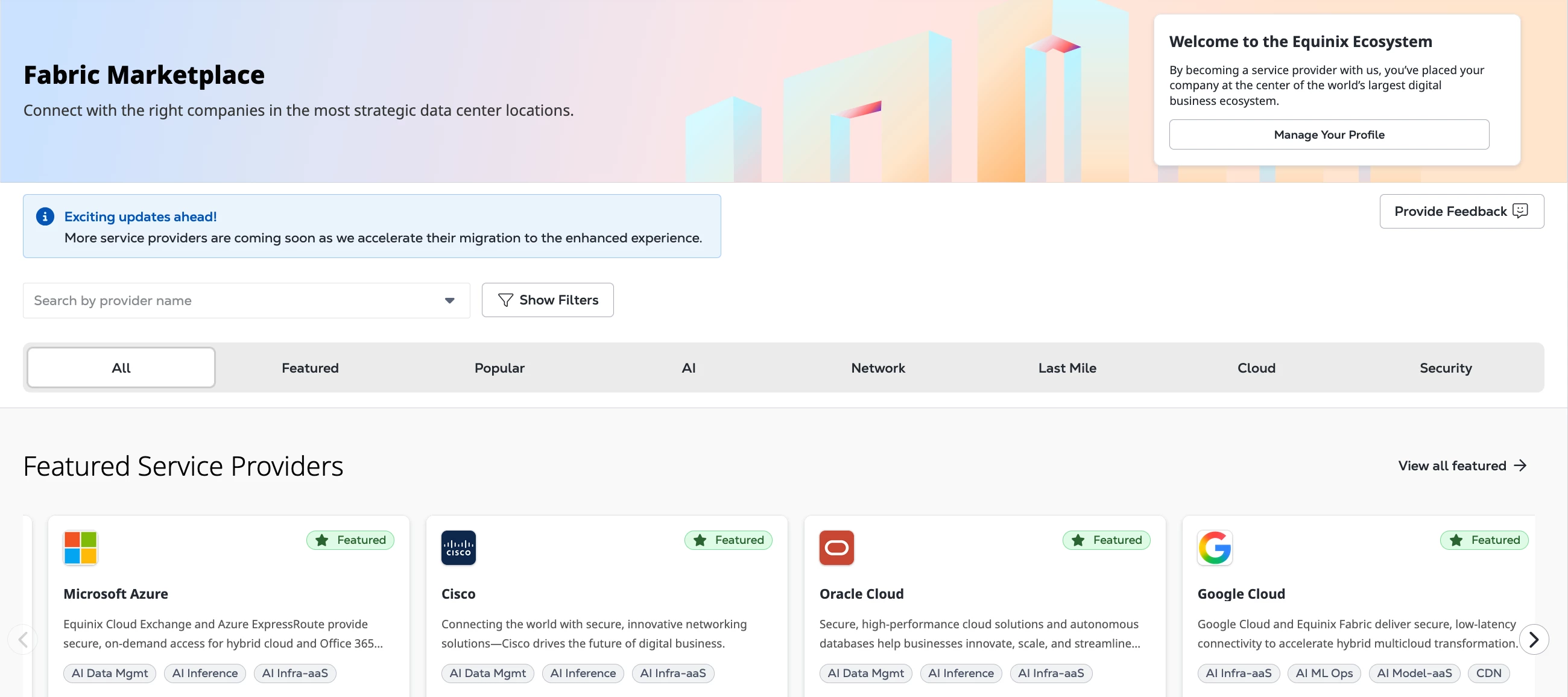
The Fabric Marketplace Provider Dashboard introduces provider health insights, including port utilization, inventory, and connected customers visibility, helping providers monitor and manage marketplace performance.What’s New:New provider dashboard available within Fabric Marketplace Displays provider health insights, including port utilization and inventory Provides visibility into connected customers and marketplace performanceWhy it Matters: Helps providers monitor the health and performance of their marketplace offerings Provides visibility into utilization, inventory, and customer connectivity to support ongoing managementLearn More Explore Fabric Marketplace
The Challenge:Organizations increasingly rely on cloud services and hybrid multicloud architectures, but achieving reliable, high-performance connectivity to cloud providers can be complex. Establishing direct peering relationships often requires specialized networking expertise and ongoing operational management.Many organizations need a simpler way to access Google services with enterprise-grade performance and reliability, without managing peering relationships themselves.A Better Approach:Equinix Internet Access (EIA) is now a Google Gold Verified Peering Provider, enabling customers to access Google connectivity through an approved provider rather than managing a direct peering relationship themselves.This approach gives customers a private, off-internet peering path from EIA to Google’s public services – provisioned and operated by EIA, so customers don’t have to qualify for or manage Direct Peering themselves.When to Use This:When connecting to Google services and seeking a simp
Online IP Block Management gives EIA customers the ability to independently purchase and manage Internet IP Blocks — directly in the portal, on their own timeline.What’s New:Customers can independently manage Internet IP Blocks associated with EIA services IP Block lifecycle management is now decoupled from EIA service fulfillment Customers can retain and reuse Internet IP Blocks across different EIA services as business needs evolveWhy it Matters:Gives customers greater control over Internet IP Block lifecycle management Decouples IP Block management from EIA service fulfillment, providing more flexibility in IP address planning Allows customers to retain and reuse IP Blocks even when an associated EIA service is terminated Enables self-service management directly in the portal, reducing dependency on manual processes or support requestsLearn MoreEquinix Documentation - EIA
Network Edge now includes Palo Alto Networks Prisma AIRS, a marketplace offering designed to help protect AI workloads through real-time AI security and policy enforcement.What’s New:Palo Alto Networks Prisma AIRS is now available through the Network Edge marketplace Introduces real-time AI security capabilities for AI workloads Provides policy enforcement designed to help reduce threats and prevent data leakageWhy it Matters:Helps organizations protect AI workloads Provides security and policy enforcement capabilities through the Network Edge marketplaceLearn MoreNetwork Edge Documentation Securing AI workloads with Equinix and Palo Alto Networks Equinix Unveils the Distributed AI Hub to Simplify and Secure Enterprise AI Infrastructure
New IBX facilities are now open in Madrid, Spain (MD5) and Silicon Valley, California (SV18), expanding Equinix colocation presence in these markets.What’s New:MD5, a new Equinix IBX facility in Madrid, Spain is now open SV18, a new Equinix IBX facility in Silicon Valley, California is now open These openings expand Equinix colocation infrastructure in both marketsWhy it Matters:Provides additional Equinix colocation capacity and presence in Madrid and Silicon Valley Expands infrastructure availability for customers deploying in these strategic marketsLearn MoreColocation Documentation Equinix reinforces its colocation offer with the inauguration of MD5 in Alcobendas
Network Edge has expanded into Kamloops, British Columbia, giving customers in Western Canada a closer deployment option for virtual network services.What’s New:Network Edge now available in Kamloops, British ColumbiaWhy it Matters:Reduces latency for customers deploying virtual network services closer to end users in Western Canada Supports regional deployment consistency for organizations with infrastructure or compliance requirements tied to British ColumbiaLearn MoreNetwork Edge Release Notes | Equinix Product Documentation
Summary:100 Gbps virtual circuit availability on Equinix Fabric has expanded to Los Angeles, supporting high-throughput workloads in the region.What’s New:100G virtual connections now available in Los AngelesWhy it Matters:Gives customers in Los Angeles access to high-throughput connectivity without needing to route through other locations Supports demanding workloads that require 100 Gbps capacity closer to where infrastructure is deployedLearn More:Equinix Fabric Release Notes | Equinix Product Documentation
We are excited to announce a significant architectural evolution in our sovereignty controls. While geo-boundary enforcement has historically resided at the Fabric port level, we have successfully extended this capability down to the Network Edge virtual device itself. This upgrade empowers customers to define and enforce Geo Zones when the Network Edge is the originating endpoint of a Fabric connection. You can now provision and validate this constraint directly via the UI or API, ensuring compatibility checks run before provisioning commits. This proactive validation removes the risk of post-deployment configuration mismatches. This feature is live today across GCP, AWS, and Oracle Quick Connect, supporting both VD-to-Port and VD-to-CSP provisioning paths. (A note for your integration specialists: The API layer for this specific implementation is delivered by the Fabric team.)
Summary:Fabric Geo Zones now extends to the European Union, enabling customers to create secure port-to-port connections across qualifying EU metros with traffic constrained to EU sovereign boundaries.What’s New:EU Geo Zone now available, supporting port-to-port connections between qualifying EU metros including Paris, Frankfurt, Amsterdam, Madrid, Lisbon, Stockholm, and Helsinki Customers can optionally enforce EU-only routing to ensure all traffic stays within EU infrastructure Available via UI and API, supporting EPL, EVPL connections and connections to Service ProvidersWhy it Matters:Enables organizations in regulated industries – including government agencies and enterprises with AI workloads – to meet EU data sovereignty and regulatory requirements like GDPR directly within Fabric Removes the need for bespoke network engineering to enforce EU-only routing across multicloud and partner ecosystemsLearn More:Docs Fabric Geo Zones Demo Fabric Geo Zones Press Release The EU Data Sover
How do I connect my organization’s AWS account to Equinix. What information and steps are required from our side?
Fabric now supports 100G virtual connections in Miami, enabling higher-capacity connectivity for customers in this metro.What’s New:100G virtual connections now available in Miami Increases maximum bandwidth capacity for Fabric in this locationWhy it Matters:Enables high-throughput, performance-sensitive workloads with fewer connections Benefits customers in or connecting through Miami needing greater bandwidthLearn More:Equinix Fabric Release Notes | Equinix Product Documentation
We are only using ½ a rack at MI1 and ½ of our power allotment. If anyone is interested in sharing, please contact me at jay@dslx.net
Equinix Managed Solutions has expanded into Los Angeles, bringing managed solutions availability to the US West Coast.What’s New:Equinix Managed Solutions now available in Los AngelesWhy it Matters:Extends managed solutions availability to customers on the U.S. West CoastLearn MoreManaged IT Services for the Managed Data Center | Equinix
The Challenge:Customers in regulated industries must prove that sensitive traffic stays within specific jurisdictions – not just where data is stored, but where packets travel. For teams running virtual network services on Network Edge, this has meant relying on approaches that lack deterministic routing control or fine-grained egress enforcement, forcing trade-offs between performance and compliance.A Better Approach:Fabric Geo Zones now extends to Network Edge connections, enabling customers to apply geographic boundaries directly to Network Edge ports:Keeps Fabric network traffic within defined sovereign boundaries for Network Edge ports Allows additional endpoints to operate within geo-defined data zones Extends policy-based, jurisdiction-constrained routing to virtual network services at the edge – without adding routing complexityWhen to Use This:When deploying Network Edge services that must stay within sovereign or compliance-defined geographic boundaries When extending data so
Welcome to the new Product Release Notes section in Community - your central destination for staying up to date on newly released Equinix product capabilities, enhancements, and expansions. The Product Release Notes section is designed to help you quickly understand what’s new across our portfolio, why it matters, and how new capabilities can help you solve business and technical challenges. As innovations move from roadmap to delivery, you’ll find a range of content here, including: New product introductions Feature enhancements Product and market expansions Our goal is to create a single, easy-to-navigate destination that helps you stay informed about the latest innovations across Equinix. We encourage you to: Subscribe to this page to receive updates Leave comments and questions for product teams We’re excited to launch this new resource and look forward to continuing to expand it with new content over time.
Fabric now includes a native Insights Hub dashboard in the Fabric Portal, giving customers real-time, unified visibility into network performance and health without relying on external tools or customer integrations.What’s New:Native events and alerts dashboard now available directly in the Fabric PortalWhy it Matters:Network and operations teams can monitor, troubleshoot, and understand their Fabric environment faster – without needing to build or maintain custom integrations Reduces dependence on external observability tools by bringing network health visibility natively into FabricLearn More:Docs Fabric Insights Demo Fabric Intelligence Whitepaper Omdia Analyst Paper
What’s New: EMS Managed Private Storage Block/File Summary:EMS Managed Private Storage Block/File 1.1 expands managed private storage with Network Attached Storage (NAS) and block modalities, along with built-in replication to improve performance, resiliency, and data protection. What’s New:Expanded managed private storage to include NAS and block modalities Added built-in replication capabilities Enhancements aimed at improving performance, resiliency, and data protectionWhy it Matters: Provides improved performance, resiliency, and data protection for storage workloads Benefits customers leveraging managed private storage who require enhanced storage capabilitiesLearn MoreDocumentation - Managed Solutions
Summary:Network Edge has expanded into Johannesburg, giving customers in South Africa a closer deployment option for virtual network services. What’s New:Network Edge now available in Johannesburg, South Africa Why it Matters: Reduces latency for customers deploying virtual network services closer to end users in South Africa Supports regional deployment consistency for organizations with infrastructure or compliance requirements tied to South Africa Learn MoreNetwork Edge technical documentation
Already have an account? Login
Enter your E-mail address. We'll send you an e-mail with instructions to reset your password.