
Fabric Geo Zones (Preview): When to Use it And What to Expect
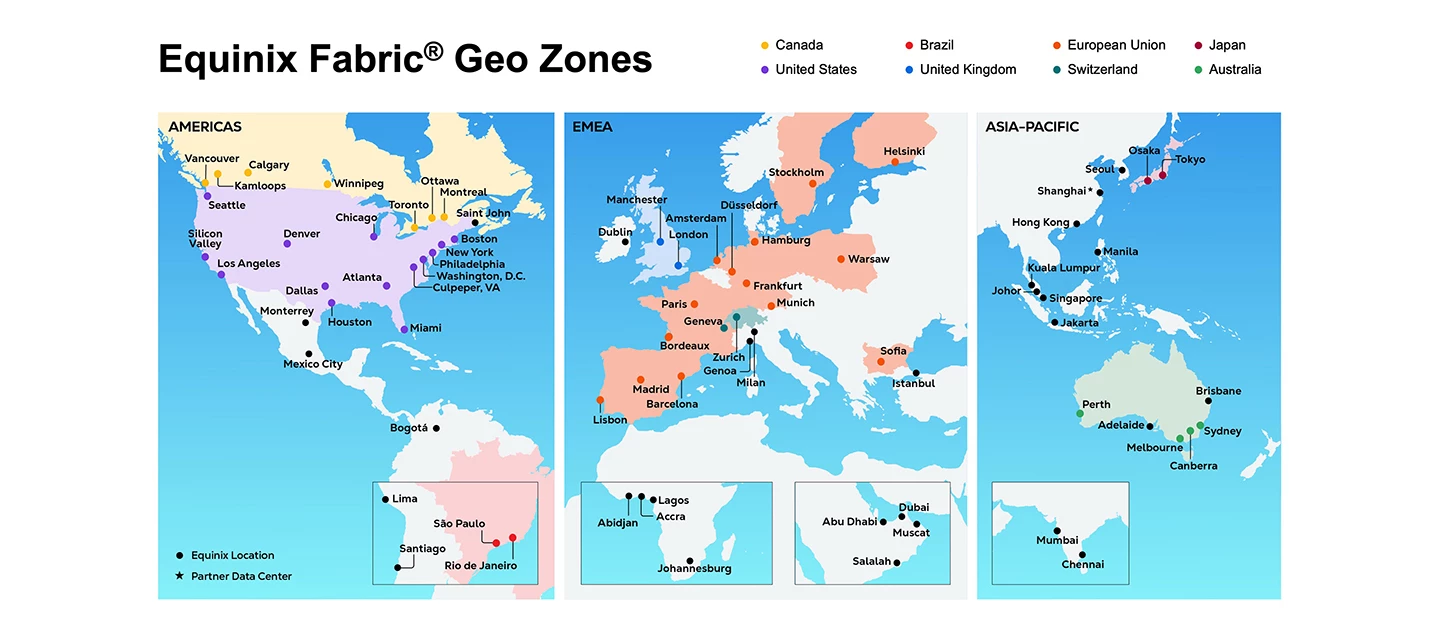
The Challenge:
As organizations scale across regions and clouds, ensuring that sensitive data stays within specific geographic or jurisdictional boundaries becomes increasingly complex. Today, teams often struggle to:
- Prove that data-in-motion stays within required jurisdictions (not just where it’s stored)
- Enforce deterministic routing paths across multicloud and partner ecosystems
- Meet regulatory requirements like GDPR, DORA, or healthcare and government policies
Existing approaches often rely on public internet routing, cloud provider backbones, or custom-built architecture that could lack control, forcing tradeoffs between performance, compliance, and operational complexity.
A Better Approach:
Fabric Geo Zones (Preview) introduces a new way to define and validate geographic traffic boundaries directly within Equinix Fabric.
- Enables policy-based, jurisdiction-constrained routing (e.g., USA-only, EU-only)
- Introduces Network Zones to control how and where traffic flows
- Provides foundational observability to validate whether traffic aligns with defined policies
- Customers define routing boundaries through Network Zones; Fabric applies those constraints during path selection
- Additional enforcement and IAM controls are planed ahead of general availability – this preview is designed to help teams validate workflows and provide input before GA
When to Use This:
- When validating data sovereignty or compliance requirements (e.g., GDPR-aligned routing)
- When designing architectures that require traffic to stay within defined geographic boundaries
- When testing early implementations of policy-based routing across Fabric and multicloud environments
When Not to Use This:
- When full production enforcement or complete feature maturity is required
- When advanced observability or independent verification of routing guarantees is needed
How it Works:
Fabric Geo Zones introduces policy-driven controls within the Fabric layer to define where traffic is allowed to flow. At a high level:
- Customers define geographic or jurisdictional boundaries through Network Zones
- Fabric applies policy-based routing constraints aligned to those boundaries
- Observability capabilities provide insight into traffic behavior relative to defined policies
- IAM updates support controlled access to policy configuration and management
Expected Outcomes:
- Performance: Predictable traffic behavior aligned to defined routing policies
- Cost: Reduced need for bespoke network engineering to meet sovereignty requirements
- Risk: Improved ability to align with regulatory and compliance mandates for data-in-motion
What This Means For You:
For teams operating in regulated industries, Fabric Geo Zones removes the need to build custom network architecture to meet data sovereignty requirements. You can now define jurisdiction-constrained routing directly within Equinix Fabric, validate it early, and feed back into the GA roadmap.