
Securing and governing distributed AI with F5 AI Guardrails on the Equinix Distributed AI Hub

1.0 The packet is now the prompt
Network and security architecture has always centered on a single unit of inspection: the packet. Routers move it. Firewalls inspect it. Logs record it. Every control point in the stack was built to act on the source, destination and port.
AI breaks that model. The thing you now need to route, inspect and log is no longer just the packet—it's the prompt. A request like "summarize this customer record and email it" carries no useful signal in the packet header. The risk lives in the content, the intent and the identity behind the request. Decisions have to reflect what the prompt is asking, not just where it's headed.
This shift from address-based control to content-based control explains why the same three functions you already deployed for the network, routing, firewalling and logging, are evolving into the AI gateway, AI guardrails and AI observability. This isn't something you bolt onto an application. It's critical infrastructure that demands the same strategic thinking you already apply to the network, now applied to the prompt. That is the exact problem F5 and Equinix built a joint architecture to solve.
This is familiar territory for Equinix. The same architecture we've helped enterprises build for years, private interconnection, on-path enforcement and distributed control points close to where traffic actually flows, is the architecture that secures AI traffic today.
According to F5's 2026 State of Application Strategy Report, enterprises now run an average of seven AI models at the same time, 78% operate their own AI inference infrastructure and 98% are actively preparing for agentic AI. AI has moved from experimentation to production, and governance has to catch up—at both the application layer and the infrastructure layer. That is what the Equinix Distributed AI Hub and F5 AI Guardrails deliver together.
Read the full F5 partnership blog: How F5 and Equinix help secure and govern distributed AI
F5 solution guide: F5 AI Guardrails for Equinix Distributed AI Hub
Demo Video: F5 AI Guardrails Data Leakage Prevention in Equinix AI Hub
2.0 The AI security challenge
Generative AI applications and agentic workflows create attack surfaces that differ fundamentally from traditional application security threats:
- Prompt injection. Attackers embed hidden instructions in user inputs or retrieved content to override model behavior, bypass safety controls or extract system prompts. These attacks stay invisible to perimeter security tools that inspect network traffic patterns rather than semantic content.
- Data leakage at the inference layer. Sensitive enterprise data, PII and credentials routinely end up in prompts sent to large language models (LLMs). Without inline inspection, that data can reach external model providers or surface in model responses with no policy control.
- Policy drift across models and environments. As you deploy agents and models across hybrid environments, governance policies defined in one context don't automatically carry over to others. Each new AI solution becomes a new compliance gap.
- Shadow AI. Teams connect to AI APIs on their own. Workflows get built without security review. Audit trails stay incomplete or missing. When regulators or incident responders ask for evidence of oversight, the documentation isn't there.
- Agentic AI risk. Autonomous agents make decisions and take actions across systems. Without real-time controls on what an agent can request, retrieve or transmit, a single compromised or misconfigured agent can cascade across an entire workflow.
Most organizations have no central answer to these risks. They leave each application team to police itself, and every team decides which guardrails to apply—if any. The result is a different security solution per application, per cloud, per team and per model. Some teams build it well. Some don't build it at all. And there's no single place to look to know which is which.
3.0 Equinix Distributed AI Hub: platform architecture
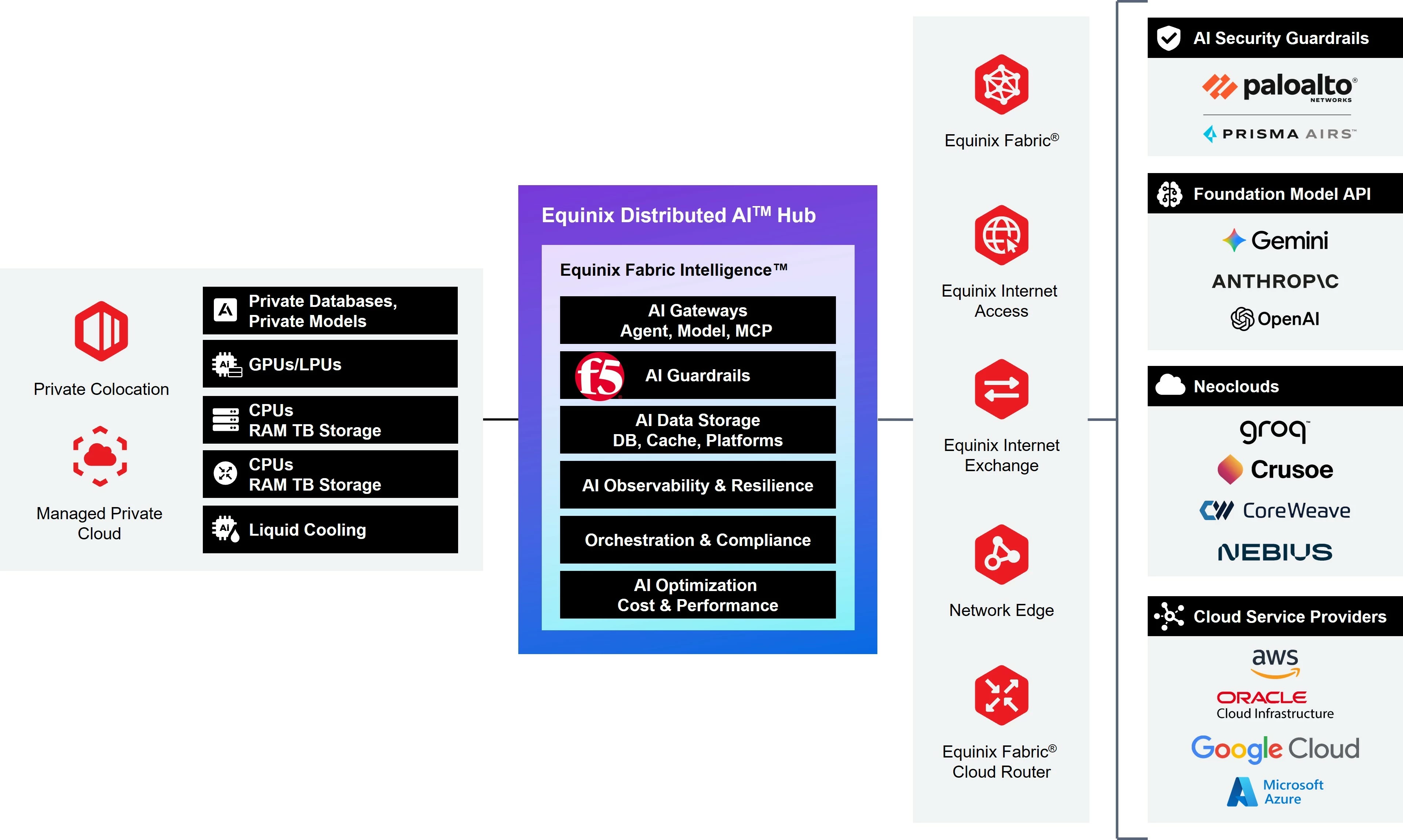
The Equinix Distributed AI Hub runs on the same global interconnection infrastructure that thousands of enterprises already depend on. What's new is the ecosystem we're assembling on top of it: AI partners and cloud providers brought together to address AI-specific governance challenges. You get to run AI workloads where they perform best, because the underlying network is built, proven and already carrying production traffic.
Global data center footprint
More than 280 data centers across 77 metros support data sovereignty and edge inference.
Equinix Fabric®
Software-defined, private, low-latency virtual circuits reach thousands of service providers.
Cloud on-ramps
Direct access connects you to AWS Direct Connect, Azure ExpressRoute, Google Cloud Interconnect and Oracle FastConnect.
Equinix internet exchange
Direct peering to external providers happens at the same location as inference and enforcement.
Physical cross connect
Sub-millisecond fiber links co-located or adjacent-data-center infrastructure.
Global ecosystem reach
More than 10,000 ecosystem partners span enterprises, network service providers and cloud and IT service providers.
The Distributed AI Hub is open and vendor-neutral by design. You can compose AI stacks from best-of-breed providers and optimize for cost, performance and sovereignty at the same time.
4.0 F5 AI Guardrails: AI-native policy enforcement
F5 AI Guardrails inspect and secure both prompts and responses in real-time. Deployed on-premises at Equinix data centers, they deliver real-time, runtime, AI-native policy enforcement on every prompt and response flowing through your AI infrastructure.
Unlike traditional application security tools that inspect HTTP traffic patterns, AI Guardrails understand the intent behind an AI interaction, not just where the packet is headed.
- AI-native policy engine. Detects prompt injection and data leakage at the semantic level, not just the network level.
- Data loss prevention. Inspects prompts and responses inline to detect and block PII, credentials and proprietary context before it leaves controlled environments.
- Outcome analysis and traceability. Generates an audit-ready evidence package with traceable reasoning for every enforcement decision, not just a log line.
- Adaptive policy engine. Maintains governance continuity as you add new models or shift providers, so you rarely have to redefine policy when the model roster changes.
- Broad set of out-of-the-box guardrails. Out-of-the-box policy profiles, including compliance, PII protection, and other AI guardrails, align with GDPR, HIPAA, and the EU AI Act, giving organizations a defensible position from day one.
- Custom guardrails. Tailor guardrails to your specific use cases. Multiple options are available for defining custom guardrails, including natural-language policy creation guided by an integrated F5 AI Assistant that reviews and refines definitions using F5 best practices.
- On-premises and hybrid deployment. Scales from a single guardrail instance to large AI factories, including data-sovereign and air-gapped environments.
5.0 Why deploy F5 AI Guardrails at Equinix
Deploying F5 AI Guardrails inside an Equinix data center is architecturally different from deploying it in a cloud. The difference comes down to where the control point sits relative to the traffic it governs—and that placement decision directly shapes the security posture, performance and compliance coverage of your deployment.
5.1 Private connectivity via Equinix Fabric
When F5 AI Guardrails runs at Equinix, connections between your infrastructure, the guardrail enforcement layer and your LLM endpoints travel over an Equinix Fabric virtual circuit, not the public internet. AI traffic—prompts, responses and any sensitive context F5 inspects—stays within Equinix's controlled network from origin to destination. This is the architectural foundation for data sovereignty. Enforcement happens on traffic that never leaves private infrastructure.
5.2 On the path, not off it: where the control point sits matters
A correct network with a misplaced control point still fails. It's not enough to deploy AI Guardrails somewhere. They should sit on the path your AI traffic already takes, not off to the side.
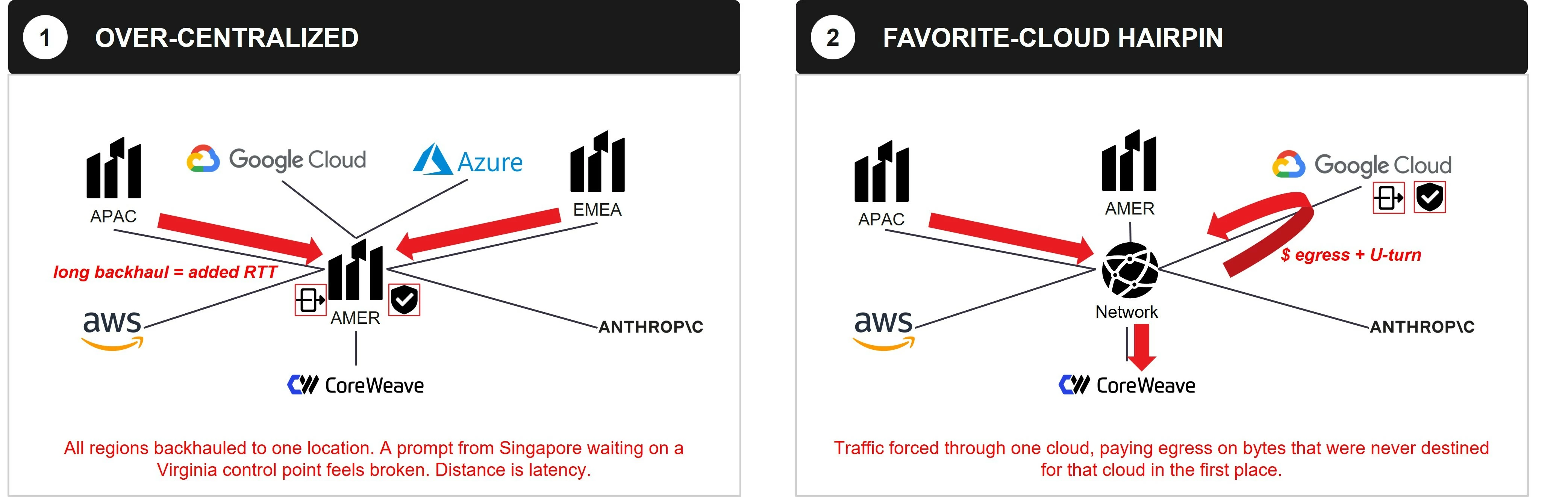
Consider a gateway or guardrail layer hosted in a single cloud region. Every other region and every other cloud now has to detour to reach it: extra hops, variable time-to-first-token, egress charged on every byte and enforcement quality that varies with distance. Every packet still gets inspected, but the setup is operationally broken—because distance is latency, and a single control point becomes both a bottleneck and a liability.
At Equinix, the control point sits at the intersection of your network: the place where your clouds, GPUs and data already meet through Equinix Fabric, cloud on-ramps and internet exchange. F5 AI Guardrails become an inspection point on a path the traffic was already taking, not a detour. Every cloud you connect to, AWS, Azure, GCP, neoclouds, and your private inference intersect at Equinix through Fabric, where inspection happens inline on that existing path.
5.3 Avoiding the two anti-patterns that break AI governance at scale
Two failure modes show up repeatedly when enterprises try to centralize AI governance without rethinking where the control point lives:
- Over-centralization. Backhauling every region's AI traffic to one control point—for example, routing all of AMER, EMEA and APAC to a single Virginia gateway. A prompt from Singapore waiting on a Virginia enforcement point feels broken, because distance is latency.
- Favorite-cloud hairpin. Routing AI traffic through a gateway hosted in one cloud provider even when the real destination is a different cloud, an on-premises system or an external API. Every byte pays egress on a U-turn it never needed to make.
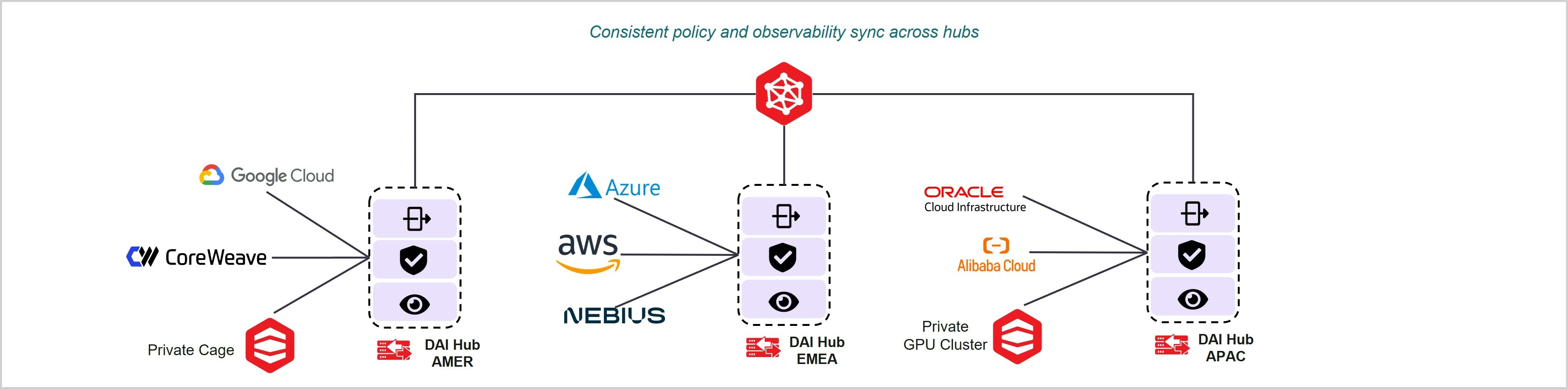
The fix for both is the same. Equinix's global footprint lets you deploy AI gateway, AI guardrails and AI observability in the metro closest to where each region's AI workloads run, or wherever your traffic concentrates, while keeping policy enforcement consistent across every hub. Traffic stays local. Governance doesn't fragment. No single hub becomes a chokepoint or a single point of failure.
5.4 colocation with inference infrastructure
Placing F5 AI Guardrails in the same data center as your GPU inference servers—or in an adjacent data center connected by physical cross connect—turns the guardrail hop into a sub-millisecond fiber connection rather than a network round-trip across availability zones or cloud regions. You get inline, real-time policy inspection with no meaningful performance penalty on your AI workloads.
5.5 Secure Cabinet Express for air-gapped deployments
Some organizations require on-premises-equivalent isolation—financial services, defense contractors and regulated healthcare among them. Equinix Secure Cabinet Express provides a locked, access-controlled, individually alarmed cabinet within a data center. It delivers air-gapped AI enforcement with the physical security that data-sovereign environments demand.
5.6 Optimized access to external AI APIs
For workloads that call external LLM providers, Equinix internet exchange provides direct peering at the same location where F5 AI Guardrails runs. F5 inspects outbound AI API traffic before it reaches the internet. The path to external AI providers becomes a short, direct, low-latency connection rather than a multi-hop public internet route—where you pay for the port, not the bandwidth.
5.7 Strategic enforcement points across the full ecosystem
The Equinix ecosystem includes more than 10,000 partners—network service providers, cloud on-ramps and AI infrastructure and data providers—all reachable through Equinix Fabric from the same data center where F5 AI Guardrails is deployed.
A single F5 enforcement point governs AI traffic flowing to and from any combination of cloud providers, private models and external APIs, without a separate security stack in each environment. One policy set. Consistent enforcement. Full visibility across the entire AI workflow—and a control plane built for the architecture you'll have in 18 months, not just the one you have today.
5.8 Compliance built into the facility
Equinix data centers hold compliance certifications that commonly include SOC 1 Type II, SOC 2 Type II, ISO 27001, ISO 22301, ISO 9001, ISO 50001, PCI DSS, HIPAA, NIST 800–53 / FISMA High and LEED.
The physical and operational controls come with the colocation environment where F5 AI Guardrails runs—not as a separate compliance exercise layered on top. Combined with F5's pre-built GDPR, HIPAA and EU AI Act guardrail profiles, your risk and compliance teams inherit a certified infrastructure foundation and a pre-built policy layer, rather than building both from scratch.
6.0 Reference architecture
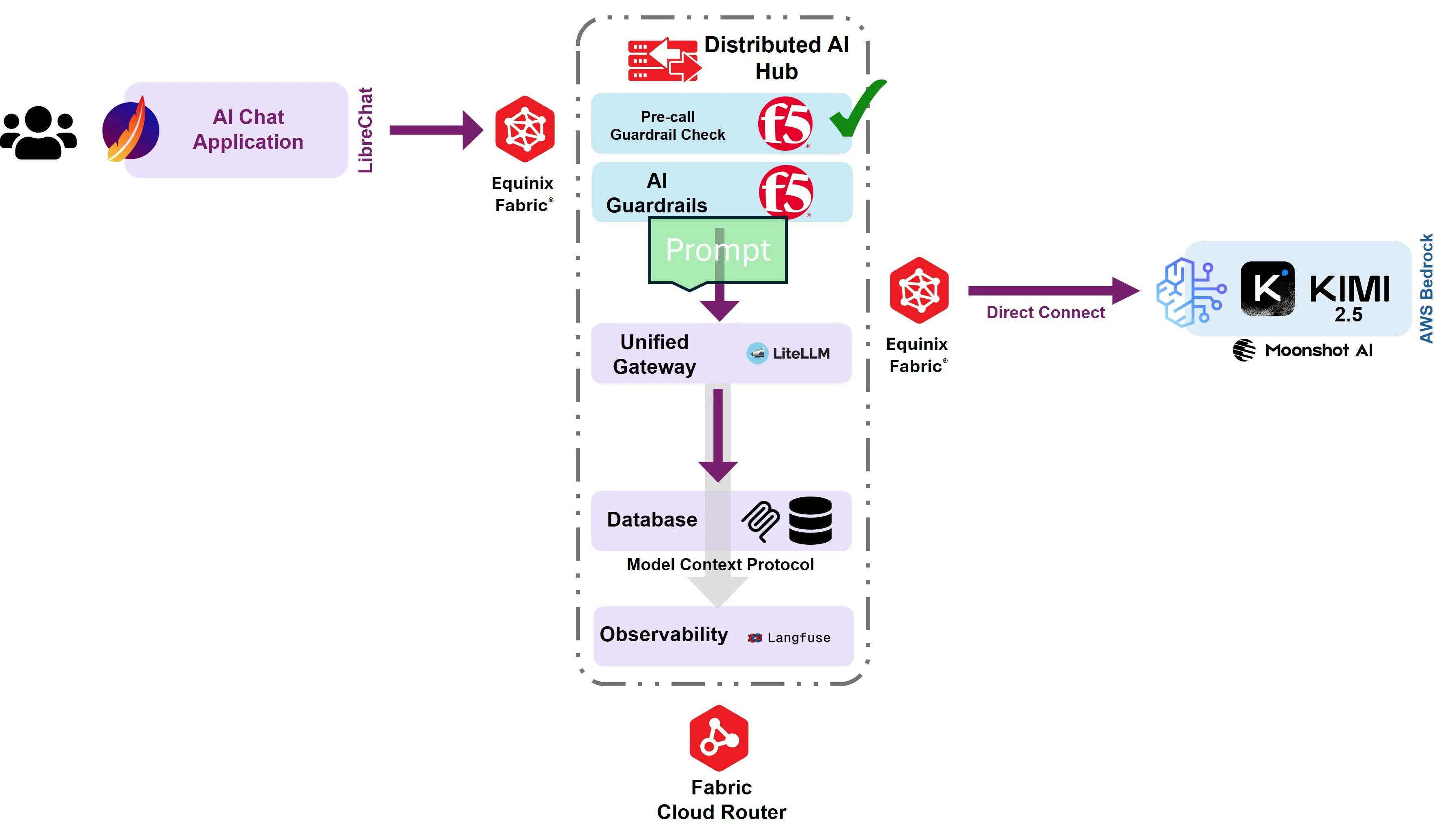
F5 AI Guardrails deployed within an Equinix data center follows a clear path:
- A user or agent request originates from the enterprise environment.
- The request routes over Equinix Fabric to the regional hub where F5 AI Guardrails is deployed.
- F5 inspects the prompt and applies DLP, injection detection and policy controls—on the path, not off it.
- The approved request routes to inference infrastructure: a co-located GPU cluster, a cloud on-ramp (Direct Connect or ExpressRoute) or an external API.
- The model response returns through F5 for outbound inspection.
- The compliant response returns to the application, and the enforcement decision is logged with full traceability.
7.0 Why F5 and Equinix benefit the end customer
For the end user, the integrated F5 and Equinix setup shifts AI governance from a scattered, application-specific task to a unified infrastructure feature. Instead of each team, cloud platform, or AI app having to create its own safeguards, customers get a uniform enforcement layer that manages policy application prompts and responses as AI traffic moves through the system. This minimizes governance fragmentation, enhances visibility, and provides security, compliance, and platform teams with a single, robust control framework for distributed AI.
The customer gains private enforcement that occurs along the existing network path. When F5 AI Guardrails operates within an Equinix data center, AI traffic can use Equinix Fabric virtual circuits instead of the public internet. This keeps prompts, responses, and sensitive data within secure, controlled network routes. Enforcement happens where traffic naturally flows, avoiding extra detours, thus allowing customers to enhance their privacy and data sovereignty without increasing architectural complexity.
This design enhances customer experience and operational efficiency. By positioning guardrails near inference infrastructure, cloud on-ramps, and external AI providers, customers can reduce latency, egress costs, and reliability risks tied to overly centralized gateways or preferred-cloud hairpin routing. Regional Equinix hubs enable customers to keep AI traffic local while applying consistent policies across different environments, ensuring AI applications remain responsive as usage grows across regions, models, and cloud providers.
For customers with regulation and risk concerns, the joint solution provides a more straightforward route to deploying AI. F5 offers AI-native inspection, data loss prevention, prompt-injection detection, traceability, and ready-made compliance guardrails. Equinix adds a global interconnection footprint, private connectivity, partner reach, and facility-level compliance support. Together, they enable customers to transition more quickly from testing to governed AI production, all while maintaining flexibility over models, clouds, private inference, and external AI APIs.
The main advantage for the end customer is clear: faster AI adoption with less risk. Customers can deploy AI in the most effective areas, keep sensitive data secure, enforce policies consistently, generate documentation ready for audits, and prevent the need to reconfigure security controls every time a new AI workload is introduced. F5 and Equinix provide a governed AI foundation that is naturally distributed, compatible with hybrid multicloud setups, and ready for the changing landscape of agentic AI workflows.
7.0 Summary
| Challenge | Equinix and F5 |
|---|---|
| AI traffic traversing the public internet | Equinix Fabric private virtual circuits, with no public internet exposure |
| Control point present but poorly placed | On-path deployment at the Equinix hub, not a detour |
| Over-centralized or favorite-cloud hairpin routing | Regional Equinix hubs keep traffic local and policy consistent |
| Guardrail latency affecting inference performance | colocation and physical cross connect for a sub-millisecond enforcement hop |
| Fragmented security stacks across clouds | One strategic F5 enforcement point covers all clouds, models and APIs from one data center |
| Data sovereignty and air-gapped requirements | Equinix Secure Cabinet Express |
| Compliance evidence for GDPR, HIPAA and the EU AI Act | F5 pre-built compliance guardrails plus native physical and operational certifications |
| Incomplete audit trails for AI governance | F5 audit-ready evidence packages log every enforcement decision with traceable reasoning |
Equinix has spent years building the private connectivity and ecosystem reach that secures enterprise networks at scale. F5 brings AI Guardrails that make governance effective on every interaction. Together, we take that same proven approach and apply it to a new critical layer—the prompt—shortening the path to AI innovation you can trust.
References:
[1] F5: 2026 State of Application Strategy Report: https://www.f5.com/resources/reports/state-of-application-strategy-report
[2] F5: F5 Report 2026 AI Inferencing Has Arrived: https://www.f5.com/company/blog/f5-report-2026-ai-inferencing-has-arrived-complicating-an-already-complex-it-landscape
[3] Equinix Newsroom: Equinix Unveils the Distributed AI Hub: https://newsroom.equinix.com/2026-03-11-Equinix-Unveils-the-Distributed-AI-Hub-to-Simplify-and-Secure-Enterprise-AI-Infrastructure
[4] F5 Press Release: F5 and Equinix Secure Governed AI: https://www.f5.com/company/news/press-releases/f5-equinix-secure-governed-ai-hybrid-multicloud-distributed