Upcoming Migration: Community.Equinix.com will be read-only from April 7–16 while we move to our new platform. Learn more.
fabric
136 TopicsHave YOUR say in the redesign of the Fabric Navigation in Equinix Portal
We have an exclusive opportunity where we are redesigning the Fabric experience within the Equinix Portal to make the navigation menu easier and more intuitive. Your feedback will have a direct impact to this redesign, ensuring a seamless, intuitive user experience within Fabric portal. Interested in taking part in this 5-minute survey activity? Fill out survey below or click here to submit your feedback! Once you complete the activity, you’ll have the opportunity to sign up today for the Equinix Customer Insights Panel. Influence new ideas, processes, product releases, capabilities, and more through engaging research activities like this one! Join, shape, influence, and innovate today!1.4KViews10likes2CommentsWhat’s the quickest and slowest deployment in your career?
Minutes? Hours? Days? Months? Years? Let’s hear it! Don’t settle for months, you’ve got Equinix within minutes. Be the first to test drive Equinix Deploy and use our self-service capabilities across Equinix Metal, Equinix Network Edge and Equinix Fabric.23KViews6likes7CommentsHave you tried the Quick Connect to GCP feature for Equinix Fabric?
Quick Connect to Google Cloud Platform (GCP) is a new Equinix Fabric feature that enhances the creation of L2 connections to GCP. Instead of logging into the GCP portal to create a Google service key, all of the required provisioning steps can be performed from within the Equinix Fabric portal. Prerequisites and detailed instructions can be found in the following on-line resources. Quick Connect for Fabric 2022.3 - YouTube Quick Connect to Google Cloud Platform (equinix.com) This new feature is available today for Fabric customers adding new connections to GCP. Let us know what you think about it!5.8KViews5likes0CommentsNew Feature - Equinix Status
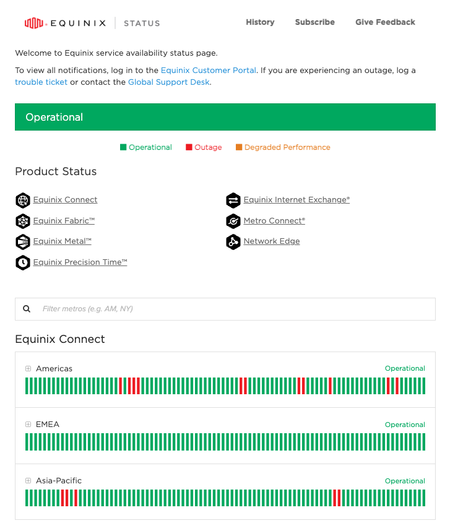
Starting today you can check the status of your network products on the new Equinix Status page. View status by product and metro for Equinix Connect, Equinix Fabric, Equinix Internet Exchange, Equinix Metal, Equinix Precision Time, Metro Connect and Network Edge. Be sure to bookmark the https://status.equinix.com/ page. We'd love to hear your thoughts, give feedback online or comment below. Learn more about Equinix Status by reading the documentation11KViews5likes2CommentsNew Term-Based Discounts for Equinix Fabric Are Here
We're excited to introduce Equinix Fabric Term-Based Discounts for inter-metro i.e. remote virtual connections (VCs) between your own assets and to your service providers including hyperscalers such as AWS, Azure, Google Cloud and Oracle. This new pricing option is designed to help you save more while enjoying the high-performance connectivity you rely on. What's New? You now have the option to select 12, 24, or 36-month contracts for inter-metro VCs from your Fabric ports, Network Edge virtual devices and Fabric Cloud Router instances. Here's how you'll benefit: Lower Monthly Rates: Save between 15% and 50% compared to on-demand pricing. For example, a 1 Gbps inter-metro virtual connection between London to New York drops from $1005/month to just $503/month with a 36-month term-based plan. See how much you can save using the Fabric pricing calculator, accessible via the Fabric portal. Simple Provisioning: No approvals required. Just select your term in the self-service portal or Fabric API and enjoy the savings. Broad Capability Support: Applicable across Point-to-Point (EPL & EVPL), Multipoint-to-Multipoint (EP-LAN & EVP-LAN) and IP-WAN services supported by Fabric Cloud Router. Also supported for Z-side service tokens. Predictable Cost Structure: Term based contracts provided set monthly rates, making it easier for you to manage your annual budget. Things to Note Discounts are available only for inter-metro VCs (intra-metro i.e. local VCs are not eligible. Discounts are currently not supported on Network Edge virtual devices to AWS, but are coming soon. Term-based discounts cannot be added to existing VCs, so you’ll need to create a new VC with your chosen term. Why This Matters By locking in discounted rates, you can optimize costs and achieve predictable spending without sacrificing performance, reliability, or flexibility. This is the perfect opportunity to create cost-efficient connectivity solutions tailored to the demands of your business. We'd Love to Hear From You Tap into these savings today by selecting a term-based discount during your next VC provisioning. We’d love to hear how this pricing option benefits your operations. Share your feedback with the team!509Views4likes0CommentsIs a Digital Services Agreement (DSA) required to order/use Fabric Cloud Router (FCR)?
Hey Community! We often get questions about Fabric Cloud Router and we’re here to help clarify for others who might have the same question in the future. If you’ve got additional questions about FCR, ask them in Community! What is a Digital Services Agreement (DSA)? The Digital Services Agreement is a document that is presented to users when setting up a Billing Account to order digital services like Fabric Cloud Router. If this is your first time ordering digital services with Equinix and you do not have an existing Billing Account (or sometimes called a Cloud Billing Account), you’ll be directed to digitally sign the DSA. If you're creating additional Billing Accounts, you will be asked whether you want to use an existing Digital Services Agreement or sign a new Digital Services Agreement. If you need guidance on either DSA option, please review this documentation. [Example only for reference and may not reflect latest version of DSA] I’m a new customer; do I need to sign a Fabric DSA? Yes, if you are a new customer and using Fabric for the first time, you’ll log into the Fabric Portal to order an FCR and be prompted to follow the click-through DSA. This is meant to allow and support our new customers who are looking to quickly onboard and use Fabric. What about if I'm an existing Equinix customer using Fabric for the first time, do I need to sign a DSA? Great question! If an existing Equinix customer clicks through Fabric for the first time they would also be prompted with the click-through DSA, however, if this customer already has an existing MCA/GTC Agreement with Equinix, these can be associated (by the Sales / Legal Ops) to a Billing Account for Fabric, and once that's correctly completed, the Billing Account should how as Active for the customer in the Portal and they will not be prompted to sign the click-through DSA. I already have a MCA/GTC agreement, but I’m getting prompted about a DSA. If an MCA/GTC agreement has been associated with the billing account for Fabric and the customer is still being prompted with the click-through DSA: The association of the MCA/GTC to the billing account may not be setup correctly and we recommend to contact support. The user logged into the Portal may not be associated with the correct Fabric Account/Project that has access to the active billing account.462Views3likes0CommentsWhat tools and vendors are folks using for multicloud networking scenarios?
Hey folks, I'm curious to hear how folks are managing multicloud networking setups. With so many tools and vendors in the space I'm eager to hear what everyone is using to connect between different cloud environments. What vendors or solutions are you using to manage multicloud networking? (e.g., Equinix, Megaport, Aviatrix, Cisco, etc.) Are you using Layer 3 or 4 networking for your interconnections? Which cloud providers or service providers are you connecting to? What’s your primary use case for these connections? (access to specific cloud services, redundancy, cost optimization, etc.) Feel free to share any challenges you've faced too!382Views3likes0CommentsWant to help us improve Metal, Fabric, and Network Edge?
We're actively working to make your experience with products like Metal, Fabric, and Network Edge better. We've put together a fairly short survey (it'll take 10 minutes) to get your input on what's working (or not!). The survey will be open through Feb 19th. Beyond helping us help you, the first 100 respondents will receive a $50 credit to the Metal store. Start the survey here.5.2KViews3likes0CommentsBeyond the Hype: The CIO's Guide to Eliminating the Hidden Costs and Complexity of AI at Scale
The promise of Artificial Intelligence (AI) is clear: groundbreaking efficiency, new revenue streams, and a decisive competitive edge. But for you, the IT leader, the reality often looks a little different. You’ve moved past the initial proofs of concept. Now, as you attempt to scale AI across your global enterprise, the conversation shifts from innovation to infrastructure friction. You’re hitting walls built from unpredictable data egress fees, daunting data residency mandates, and the sheer, exhausting complexity of unifying multicloud, on-prem, and edge environments. The network that was fine for basic cloud adoption is now a liability—a bottleneck that drains budget and slows down the very models designed to accelerate your business. I'm Ted, and as an Equinix Expert and Global Principal Technologist here at Equinix, I speak with IT leaders every day who are grappling with these exact challenges. They want to know: What are the hidden costs when training AI across multiple clouds? How do we keep AI training data legally compliant across countries and regions? How can I balance on-prem, cloud, and edge when running AI workloads without adding more complexity? How to predict and control network spend when running apps across multiple clouds? What’s the best way to ensure my AI workloads don’t go down if one cloud region fails? The short answer is: You need to stop viewing your network as a collection of static, siloed pipes. You need a unified digital infrastructure that eliminates complexity, centralizes control, and makes compliance a feature, not a frantic afterthought. In this deep-dive, we'll unpack the major FAQs of scaling enterprise AI and show you how a platform-centric approach—leveraging the power of Equinix Fabric and Network Edge—can turn your network from an AI impediment into a powerful, elastic enabler of your global strategy. Ready to architect your way to AI success? Let's get started. Q: What are the hidden costs when training AI across multiple clouds? A. The AI landscape is inherently dynamic, with dominant players frequently being surpassed by innovative approaches. This constant evolution necessitates a multicloud strategy that provides flexibility to adopt new technologies and capabilities as they emerge. Organizations must be able to pivot quickly to leverage advancements in AI models, tools, and cloud services without being constrained by rigid infrastructure or high migration costs. However, the rub is, as cloud AI training scales, network-related costs often become the most unpredictable part of the total budget. The main drivers are data egress fees, inefficient routing, and duplicated network infrastructure. Data egress charges grow rapidly when moving petabytes of training data between clouds or regions, especially when traffic traverses the public internet. Unoptimized paths add latency that extends training cycles, while replicating firewalls, load balancers, and SD-WAN devices in every environment creates CapEx-heavy, operationally complex networks. Security infrastructure for network traffic is often duplicated between clouds, leading to cost inefficiencies. The solution lies in re-architecting data movement around private, software-defined interconnection. By replacing internet-based transit with direct, high-bandwidth links between cloud providers, organizations can reduce egress costs, improve throughput, and maintain predictable performance. Deploying virtual network functions (VNFs) in proximity to cloud regions also lowers hardware spend and simplifies management. Beyond addressing hidden cost, this approach gives IT leaders the agility to scale up or down with AI demand. As GPU clusters spin up, bandwidth can be turned up in minutes; when cycles finish, it can scale back just as fast. This elasticity avoids stranded investments while ensuring compliance and security controls remain consistent across clouds and regions. By unifying connectivity and network services on a single digital platform, Equinix helps enterprises eliminate hidden costs, accelerate data movement, and ensure the network is a strategic enabler rather than a bottleneck for AI adoption. Specifically, Equinix Fabric helps customers create private, high-performance connections directly between major cloud providers, enabling data to move securely and predictably without traversing the public internet. By extending this flexibility, Equinix Network Edge allows VNFs such as firewalls, SD-WAN, or load balancers to be deployed as software services near data sources or compute regions. Together, these capabilities form a unified interconnection layer that reduces hidden network costs, accelerates training performance, and simplifies scaling across clouds. Q: How do we keep AI training data legally compliant across countries and regions? A. Data sovereignty and privacy regulations increasingly shape how and where organizations can process AI data. Frameworks such as GDPR and regional residency laws often require that sensitive datasets remain within geographic boundaries while still being accessible for model training and inference. Balancing those requirements with the need for scalable compute across clouds is one of the core architectural challenges in enterprise AI. To address this, many enterprises choose to keep data out of the cloud but near it, placing it in neutral, high-performance locations adjacent to major cloud on-ramps. This approach enables control over where data physically resides while still allowing high-speed, low-latency access to any cloud for processing. It also helps avoid unnecessary egress fees, since data moves into the cloud for analysis or training but not back out again. By establishing deterministic, auditable connections between environments leveraging private, software-defined interconnection keeps data flows under enterprise control, rather than relying on public internet paths. As a result, organizations can enforce consistent encryption, access control, and monitoring across regions while maintaining compliance. This also translates into greater control and auditability of data flows. Workloads can be positioned in compliant locations while still accessing global AI services, GPU clouds, and data partners through secure, private pathways. By combining governance with agility, Equinix makes it possible to pursue your most pressing global AI strategies while still reducing risk. Today, Equinix Fabric can support this approach by enabling private connectivity between enterprise sites, cloud regions, and ecosystem partners, helping data remain local while workloads scale globally. Equinix Network Edge complements this by allowing in-region deployment of virtualized security and networking functions, so policies can be enforced consistently without requiring physical infrastructure in every jurisdiction. Together, these capabilities offer customers a foundation for compliant, globally distributed AI architectures. As a result, customers can create network architectures that not only reduce compliance risk but also turn regulatory constraints into a competitive advantage by delivering trusted, legally compliant AI services, based on the right data at the right time in the right place at global scale. Q: How can I balance on-prem, cloud, and edge when running AI workloads without adding more complexity? A. Determining where AI workloads should run involves balancing control, performance, and scalability. On-premises environments offer data governance and compliance, public clouds deliver elasticity and access to advanced AI tools, and edge locations provide low-latency close to users and devices. Without a unified strategy, this mix can lead to fragmented systems, inconsistent security, and rising operational complexity. One effective approach is a hybrid multicloud architecture that standardizes connectivity and governance across all environments. Equinix defines hybrid multicloud architecture as a flexible and cost-effective infrastructure that combines the best aspects of public and private clouds to optimize performance, capabilities, cost, and agility. This design allows workloads to move seamlessly between on-prem, cloud, and edge based on performance, regulatory, or cost needs without rearchitecting each time. As a result, organizations can employ a hybrid multicloud architecture where policies, security, and connectivity are consistent across all environments. AI training can happen in the cloud with high-bandwidth interconnects, inference can run at the edge with low-latency access to devices, and sensitive datasets can remain on-premises to maintain regulatory compliance. This architecture enables seamless interconnection across clouds, users, and ecosystems, supporting evolving business needs.If customers utilize Network Edge VNFs they can access a control plane to manage traffic flows seamlessly across these environments, ensuring workloads are placed where they deliver the most business value with a predictable cost. It also enables the deployment of virtual network functions such as firewalls, load balancers, and SD-WAN as software services, reducing hardware overhead and improving consistency. Together, they create a common network fabric that simplifies operations, supports workload mobility, and maintains governance across diverse environments. As a result, customers can minimize complexity by centralizing management, turning what used to be a fragmented sprawl into a unified, agile, and compliant AI operating model. Q: How to predict and control network spend when running apps across multiple clouds? A. As AI and multicloud workloads scale, network costs often become the least predictable element of total spend. Massive east-west data movement between training clusters, storage systems, and clouds can trigger unexpected egress and transit fees, while variable routing across the public internet adds latency and complicates cost forecasting. These factors can make it difficult for IT and finance teams to align budgets with actual workload behavior. A more sustainable approach is to build predictability and efficiency into the interconnection layer. By replacing public internet paths with dedicated, software-defined connections, organizations can achieve elastic bandwidth scaling while having predictable billing. This model not only ensures stable and reliable network performance but also enhances cost transparency, enabling businesses to optimize their connectivity expenses while supporting evolving operational demands. Equinix Fabric supports this model by enabling private, high-performance connections to multiple clouds and ecosystem partners from a single port, fostering predictability in network performance. Equinix Network Edge complements this by allowing network functions such as firewalls, SD-WAN, and load balancers to be deployed virtually, reducing CapEx and aligning spend with actual utilization. Together, they deliver a unified network architecture that stabilizes performance, enhances cost transparency, and enables organizations to scale bandwidth effectively while managing costs in alignment with their AI and multicloud workloads. Q: What’s the best way to ensure my AI workloads don’t go down if one cloud region fails? A. AI workloads are highly distributed, and regional outages can disrupt training, inference, or data synchronization across clouds. Relying on a single provider or static internet-based paths introduces latency and failure risks that can cascade across operations. Building resilience into the interconnection layer ensures continuity even when one region or cloud becomes unavailable. The key is to design for multi-region redundancy with pre-established, high-performance failover paths. By maintaining secondary connections across clouds and geographies, organizations can automatically reroute workloads and traffic without interruption or loss of performance. Equinix Fabric enables this design by providing software-defined, private connectivity to multiple cloud providers and regions. Equinix Network Edge complements it by supporting virtualized global load balancers, SD-WAN, and firewalls that dynamically redirect traffic and enforce security policies during failover. Together, they create a resilient, globally consistent architecture that maintains availability and performance even when individual cloud regions experience disruption.477Views2likes0Comments